The spectacular rise of Artificial Intelligence (AI) has been ardently welcomed as well as anxiously feared.
In so many fields, including education, there are hopes that AI will vastly extend human capacity and the range of understanding. The power of Large Language Models (LLMs) to capture and summarise existing knowledge may provide a platform for finding new solutions to long-standing problems, and extend freedom for all kinds of creative breakthroughs in the arts and sciences. But there are also worries that AI could replace human intelligence in many areas, resulting in job dislocations and depersonalised services as well as academic cheating and bogus qualifications. The energy demands of the new data centres needed to power AI are also likely to have major social and political repercussions.
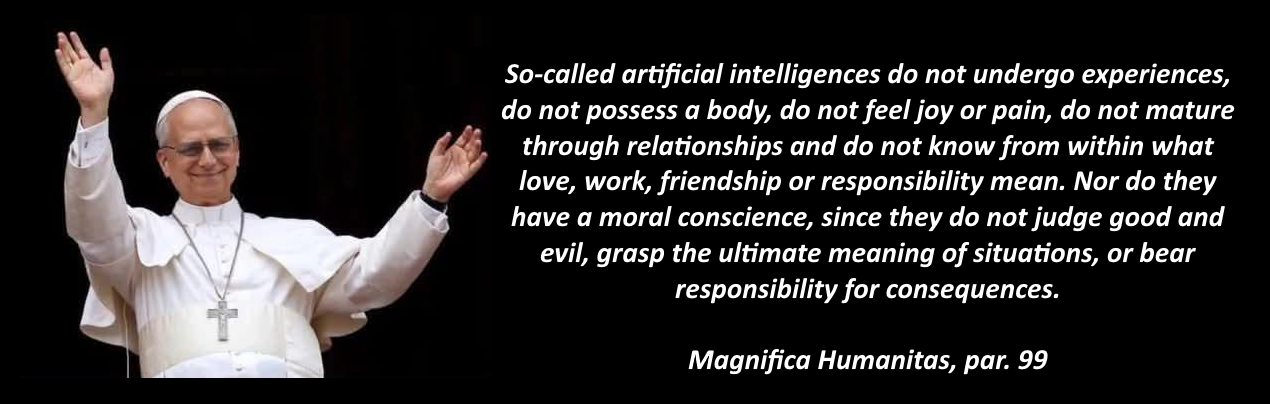
To complete the background picture, it now seems possible that AI could soon reproduce itself, generating successor systems autonomously without human guidance. Such a fear even troubles AI companies like the American-based Anthropic, which has called for a pause in AI development so as to allow societies time to manage the technology and prevent its escaping from human control. In an unusual alliance, the co-founder of Anthropic, Christopher Olah, joined Pope Leo XIV at the Vatican launch of his recent encyclical Magnifica Humanitas. The Pope described AI as “a valuable tool that requires vigilance,” and his encyclical offers a balanced perspective on the values of human dignity, the common good, and a spreading rather than concentration of technological power, that should govern this rapidly moving development. (para.96)
Possibilities for classical education
What possibilities might AI hold for classical education?
At the practical level of research and teaching, AI could bring into the broader light of scholarship various ancient documents and texts that have been lost or forgotten, and enable researchers - through tools such as Google DeepMind’s Ithaca and Aeneas - to decipher and date classical writings.
Teachers and students could benefit from the digital search capabilities that AI is adding to traditional texts like the bilingual Loeb Classical Library. This facility might yield benefits but also have drawbacks. It would give students multiple points of access to the ancient Greek and Latin, as well as to the classic works of Christian culture in later centuries, such as those of Augustine in the 5th century, Aquinas in the 13th, Dante and Julian of Norwich in the 14th. But it might also foster a complacent acceptance of quick answers and superficial understanding, deficient without context, and fail to provide a spur to greater exploration, allowing students to avoid mastering an entire text and entering into an author’s overall vision of reality.
As Pope Leo notes:
Recovering our cultural memories
Yet at a deeper cultural level, AI could serve to give new exposure to the memories of Western civilisation. It might help our culture to recover its formative traditions, literary, philosophical, theological, social and political, at a time of historical amnesia when this heritage is not only overlooked but widely disparaged.
A pivotal example of such rediscovery, which demonstrates the profound value of studying the Classics, would be the idea of citizenship in the long history of the West. Cradled in the Roman tradition of citizenship (“civis Romanus sum”), as celebrated in Cicero’s In Verrem ("Against Verres") speeches, it was used by St Paul in his own defence, in Philippi (Acts 16:37) and in Jerusalem (Acts 22:25), when his defence against unjust punishment rested on his rights as a Roman citizen, and on the responsibility of the State to recognise and respect such rights.
This balance of ideas proved to be foundational to the development of Western culture under Christian influence. As the historian Christopher Dawson pointed out in The Formation of Christendom (1967), a secular identity of common citizenship came to be enriched by the spiritual vision of equal citizenship - inspired again by St Paul (Gal 3:28): “There is neither Jew nor Gentile, neither slave nor free, neither male nor female, for you are all one in Christ Jesus."
Dawson noted the insight of the 4th century Spanish Christian poet Prudentius, who saw a providential connection between the secular and the religious identity. He believed that the Roman ideal of world unity had prepared the ground for the higher spiritual unity of the Christian Church - a remarkable illustration of nature paving the way for grace, a natural loyalty nurturing a supernatural fidelity and preparing for a divine destiny. In turn, this fundamental vision was transmitted by Augustine in the 5th century in The City of God, and by Aquinas in the 13th century in his formulation of the shared humanity of natural law.
Ignoring the past - fearing the future
A crucial part of our culture’s neglect of the past is its obsessive fear of the future. G.K. Chesterton argued that our fixation on the future - in his time buoyed by utopian hopes, in our time plagued by anxieties bordering on panic - is actually conditioned by our fear of the past. This fear, as he put it in his major work of social criticism, What’s Wrong with the World (1910), is “not merely of the evil in the past, but of the good in the past also, . . . so many flaming faiths that we cannot hold; so many harsh heroisms that we cannot imitate... the presence in the past of huge ideals, unfulfilled and sometimes abandoned."
While revolutions are clearly an overturning of the immediate past, Chesterton thought they reflected a deep yearning to recover an older past:
"Now in history there is no Revolution that is not a Restoration. Among the many things that leave me doubtful about the modern habit of fixing eyes on the future, none is stronger than this: that all the men in history who have really done anything with the future have had their eyes fixed upon the past."
He cited as examples the 16th century Renaissance, a movement of cultural rebirth based on classical Greek and Roman ideas and styles; the Protestant Reformation involving a return to the Bible and Biblical times; and the Catholic movement in the early 20th century which was inspired by the Church Fathers and the early Christian centuries.
Classical education - recovering the riches of the past
The revolution in classical education in our time can be seen, through Chesterton’s lens, as a restoration.
Classical education offers an ordered, systematic way of accessing and appreciating our fundamental traditions and understandings. Far from being a blind return to a lost past, it is a concerted attempt to recover its riches. It is a program for transforming our world by invoking the power of the past, and regaining insight into the history and philosophy and literature that formed us as a people, our ideas, our values, our imaginative stories and characters, which our culture has abandoned in a desperate search for meaning and purpose in an historical void.
It would be foolish to indulge false hopes, but might AI come to serve as a friend of classical education?
__________________________________________________________________________________________________
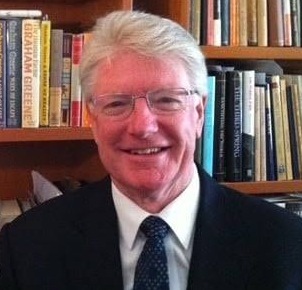 Karl Schmude is a prominent Australian author, scholar and President of the Australian Chesterton Society. He played a vital role as a founding fellow of Campion College, Australia's first dedicated liberal arts university. Additionally, Schmude has made significant contributions to Catholic education, literary studies and public intellectual life, continuing to write extensively on faith, culture, literature and education.