Fifty years ago anyone hearing the term "classical education" would take it to mean the rigorous study of the most important Greek and Latin authors - poets, dramatists, historians and philosophers - in their original languages. Traditional school curricula long focused closely on those studies. Until well into the nineteenth century the sciences and mathematics were comparative neglected, and (amazingly) English was not regarded as a proper subject for study at all! There could be no better evidence of the prevalence of this kind of education than the unofficial name given to the most prestigious degree at Oxford - Greats! The very word speaks of a world which specially revered the achievements of the great thinkers and writers of past ages almost above all else.
In the last decades of the nineteenth century this started to change. That whole century was a period of rapid scientific advance. There never was a time that saw so many astonishing changes in the daily lives of human beings and arguably there has never since been an era quite so full of marvels. Yes, we have aircraft and spaceships, and our progress in electronics is almost mind-numbing, but try to imagine the impact of countless labour-saving inventions on the life of somebody like Cardinal Newman, who lived from 1801 to 1890. In the year of his birth agriculture had been little changed for thousands of years, immense portions of the world were still unmapped, there were no anaesthetics, and the fastest form of transport was the horse. By 1890 undersea cables connected the continents and railways connected cities; there were telephones, clean water was available on tap, for many at least, cities were sewered and streets were paved, travel was fast and much safer, ships were no longer limited by wind and weather. It is difficult for us now to picture unlit cities, highways of mud, earth toilets, an almost total lack of any kind of domestic machinery, the most rudimentary and often unhygienic medical facilities. To Europeans in those early days Australia must have seemed further away that the moon: they could see the moon, but Australia was scarcely known, and what was known mostly by hearsay.
Old ways of thinking about the world had change thrust upon them. Education could no longer ignore science, but turned towards it and was thrilled by it. Scientific subjects were added to the curriculum. The amount of time needed to teach the classical languages rigorously had to be cut and the proportion of people wanting to study them inevitably dropped as well. Who of us, if we had lived then, could wholly resist the thrill of such exciting times?
In addition to the new science subjects, English also acquired respectability as a serious academic subject, and as such, proved to be a less demanding way of accessing the wisdom of the past.
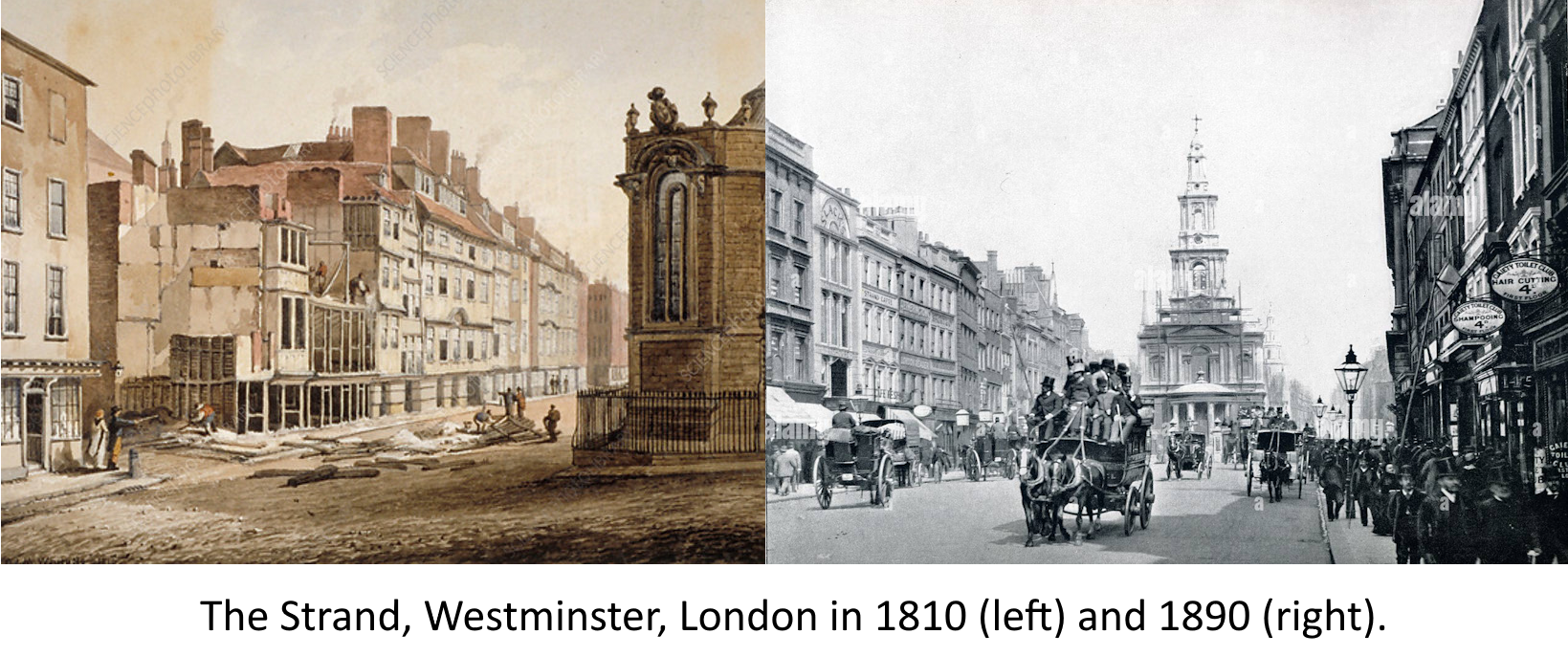
Today, having passed the first quarter of the twenty-first century, we look back on the mentality of two hundred years ago with a kind of awe. It seems hardly credible that just a few generations ago our forefathers could have thought so differently about so many things and could not have envisaged, even in their dreams, experiences and attitudes that we now think normal. Yes, "Greats" is still a degree at Oxford but few compete for it and the high bar of grammatical knowledge once required for it has been lowered.
The writers that once lorded it over the intellectual world - Homer and Virgil, Plato and Aristotle, Thucydides and Tacitus, Demosthenes and Cicero - are today still honoured as they deserve. But they have broken out and extended their influence beyond Greats and the other classics departments of the old world, and are now claimed as the patrimony of a much wider community - the faculties of history and philosophy, economics and law, English and the other vernacular languages. And thank God for that! Beyond mere survival they are probably read - at least in translation - more widely than ever before.
The very word "greats" still lingers and has acquired new life in that one special phrase: The Great Books. The notion of a canon of Great Books that influenced the world of the past, and still continue to be necessary reading for truly educated human beings, dates back a hundred years and is closely associated with names like Mortimer Adler and the Encyclopedia Britannica. The emergence in recent decades of the Classical Education movement has close links with that earlier one and generally shares its goals. So, the classics are alive and well. Along with the liberal arts tradition generally they show every sign of strong revival. It seems probable that the disastrous obsession of arts faculties in mainstream universities with various forms of narcissistic and divisive specialist studies may be contributing to the growth of independent and conservative education. That is good news for us but tragic for millions of young people who are being denied access to the fulness of liberal education.
I conclude, though, with a reflection on the state of language training that used to be the foundation of liberal education in the western civilisation. Will we return to the great days (as some would see it) of Greek and Latin being taught at a high standard in schools? If not, is that a bad thing? My answer to both questions is a qualified NO. It is no longer feasible for even a few of the best students to spend most of their schooldays on the classical languages - those times will never come again on the former grand scale. And surely it is better if the classics are read in the vernacular than not at all. Moreover, the total numbers studying the classics in one form or other is probably now greater than in any previous age.
But my qualification is this, that every translation is a secondary source, not a primary one, and that there will always be a need for people well trained in the classical languages tasked with probing, refining and elucidating the texts, and in so doing keeping our understanding accurate. It is encouraging to see so many of the new, independent classical schools that are springing up worldwide including Latin in their syllabuses. Latin was western civilisation's primary vehicle not only of communication but of intellectual exchange for at least one and a half millennia. It is the soundest base on which to construct one's studies in any of the modern European languages, and a strong case can be made its usefulness in learning non-European languages as well.
Vivat Latina!
__________________________________________________________________________________________________
 David Daintree AM is an Australian educator, scholar and medieval Latinist with a distinguished career in classical and liberal arts education. He has served as President of Campion College, Rector of St John's College at the University of Sydney and Director of the Christopher Dawson Centre for Cultural Studies. In 2017, he was appointed a Member of the Order of Australia for his contributions to education and scholarship.