For nearly ten years I have taught Euclid's Elements to twelve-year-olds. A drawer in my desk is full of colored whiteboard markers.
A student is at the board working through Proposition I.5, the one medieval students called "the bridge of asses". He has the isosceles triangle drawn. He has the two sides produced further and cut to be equal, but then he gets stuck. The proposition describes seven points, eleven lines, nine angles and five triangles all overlaid on top of one another. And the figure in front of him is a thicket of black lines that all look alike. So, I pick up the red marker and trace over a line. Then I trace another line in blue. That is enough to get him to see it. But then he goes home, opens the book, and the colour is gone.
The gap between what happened at the board and what sits on the page is what this piece is about.
What Byrne got right
Oliver Byrne put that colour into a printed version of Euclid’s Elements in 1847. His edition of the first six books of the Elements is now famous for its beautiful figures and it was reissued a few years ago as an art object. Byrne promised on his title page that his method would give the learner full knowledge of the propositions in less than one third the time usually employed. A teacher should be suspicious of that kind of promise. But Byrne was right about two things, and most teachers already use both of them in the classroom.
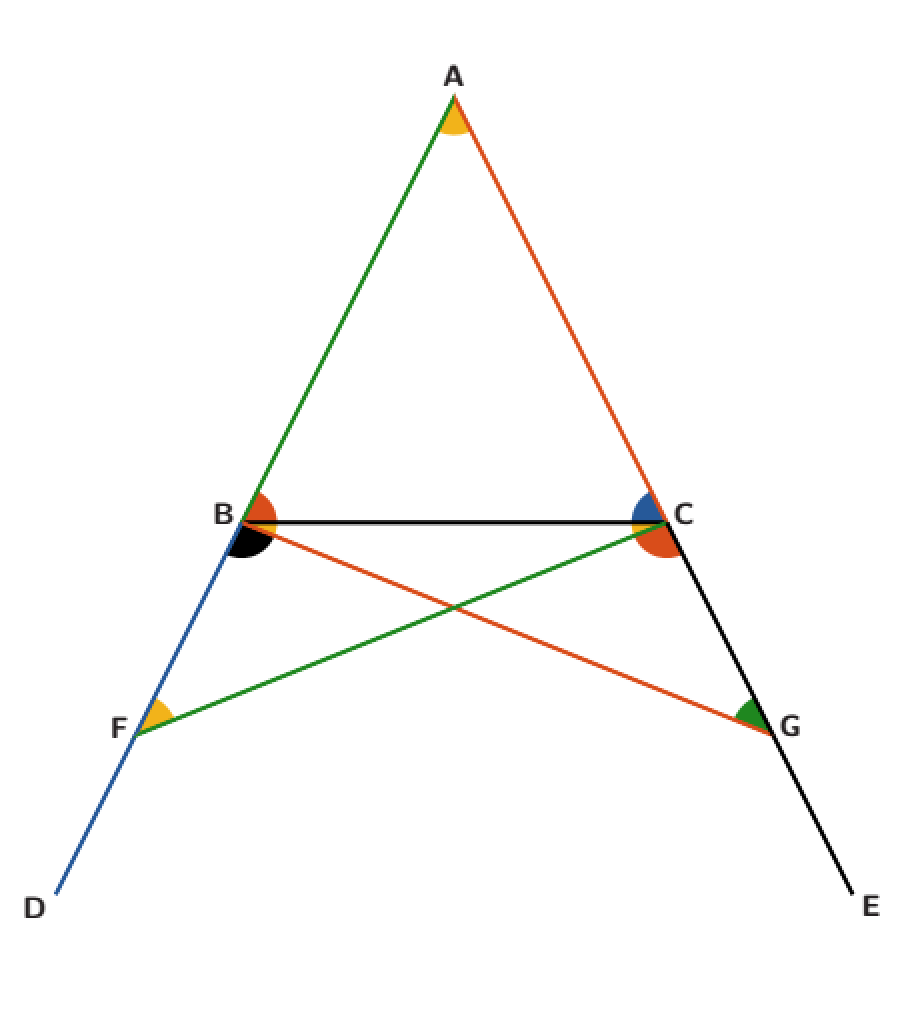
The first is that colour can aid the cognitive work required in geometry. Nearly every teacher of the Elements I have met uses it. We say "the red line" and "the green angle" because saying “line AB" requires the student to search out points while also following the argument. Beginners struggle with this and it is this task, repeated over and over, that dissuades many from persevering.
Second, Byrne did not merely colour the diagram at the top of the page. He drew the parts of the figure directly into the sentences, where the letters would otherwise be. The inline figures take the place of what the teacher says in class (“the red line” or “the green angle”) but drawing the line and the angle in the colour that corresponds to the diagram is possible and more helpful on the page.
Byrne's mistakes
To make room for the pictures, Byrne shortened Euclid.
He kept the logic of most propositions. But he erred badly on the side of brevity, and in places he cut steps that carry real argumentative weight. A student can work through Byrne's Proposition I.5 and arrive at the conclusion without ever having worked through the proof. What he has acquired is the appearance of understanding, which Socrates would tell us is worse than confusion. Knowing that you do not know makes you wiser than the one who thinks he does know but in reality does not.
Byrne's mistake is understandable and any sympathetic teacher can make it. The text is hard and the student is struggling, so, shorten the text to make it easier. But a text that has taught students for more than two thousand years should be altered only with serious forethought. If we are going to make Euclid accessible, the thing to change is not what Euclid actually said.
There is a second problem in Byrne that I did not notice until I started making my own version of the text. In many of his figures, colour signifies equality. Some lines and angles that are given as equal share a colour, and some that will be proven equal also share a colour. A student cannot tell from the page which is which. It is not only confusing, it teaches the student that equality is something you can see. A class on Euclid’s Elements should not misguide the students in this way.
A critic worth listening to
In 2023, Andrew Seeley reviewed Byrne's edition in Principia. The review is largely negative and I agree with most of it.
Seeley objects to the removal of letters from the figures because points are the principles of geometry. He objects to Byrne's handling of Postulate 5, calling it egregious, and he is right. Byrne's diagram shows parallel lines and the postulate is about lines that meet. He objects, as I do, to the modification of the text.
But he closes by granting the underlying point. “Euclid is difficult for the beginner,” he writes, “It is often helpful to make his propositions more intuitive with visual aids, such as shading or colouring.” That sentence is the motivation for this new edition of Euclid’s Elements. Everything Seeley objects to is separable from the colour. Byrne bundled colour together with a number of actual mistakes. We kept the colour and left out his mistakes.
 What we did instead
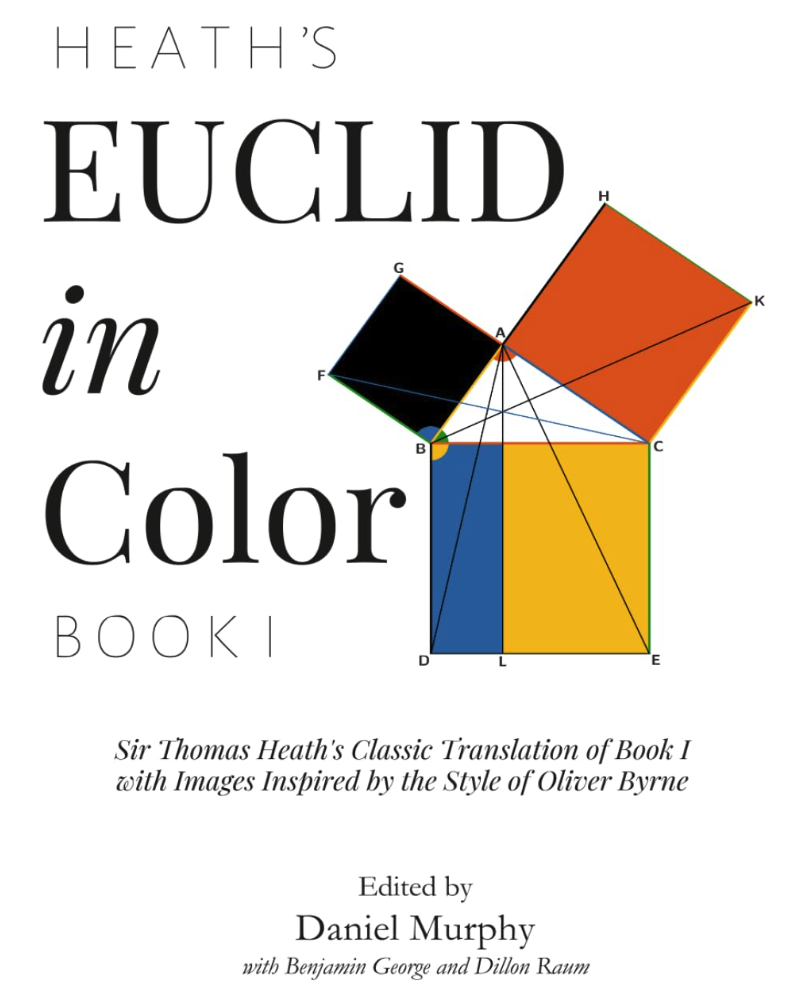
Heath’s Euclid In Colour contains Sir Thomas L. Heath's 1908 translation, complete. The point labels remain in the text and in the figures, so a student can construct the diagram entirely from the words alone. This is an essential feature of Euclid’s proofs. We used colour for reference, avoiding even coincidental signification of equality. Small figures are drawn into the sentences, alongside the words. When the text says the line AB, a coloured line AB is drawn over it. The diagrams themselves are drawn similar to the ones a teacher of the Elements will recognise from the Green Lion and Cambridge editions.
No royal road
Proclus reports that Euclid once told Ptolemy I, king of Egypt, who was struggling with the Elements, that there is no royal road to geometry. This edition does not offer one. Every proposition is Heath’s translation of Euclid. The proofs are as difficult as they have always been. The difference is that the student can see in the diagram what a sentence is talking about while he reads the proof.
The goal with this edition is to make the arduous road through Euclid’s Elements one that more people can begin with confidence. This book is for classical and liberal arts schools, homeschool co-ops, independent learners and anyone meeting the Elements for the first time.
Copies available in hardcover and paperback from Amazon.com: https://www.amazon.com/dp/B0HH48FGWB.
__________________________________________________________________________________________________

Daniel B. Murphy is a teacher at Western Academy in Houston, Texas, where he teaches physical science, geometry, Latin and woodworking. He earned his Bachelor’s in Physics at the University of Notre Dame and his Master’s in Applied Physics at Rice University. He writes about mathematics education, the history of education reform and education policy on his Substack, "What Schools Forget" and in other online journals.