 It’s common today to equate rhetoric with the ability to sustain a coherent oral argument. Within contemporary education, particularly as part of higher education certificates, students are routinely expected to articulate and defend a position on a given topic through reasoned and persuasive discourse and, to varying degrees, they are schooled in the techniques necessary to accomplish this task. Yet, such a conception of rhetoric is certainly too simplistic.
For much of Western intellectual history, rhetoric has occupied a far more significant place within a standard education. As the culminating stage of the Trivium, it represented not merely the art of public speaking but the integration of a student’s disciplined thought, moral formation and linguistic mastery, demonstrated through their clear and precise reasoning, critical judgement and sensitivity to audience and context. Of course, these skills were not isolated but embedded within a broader understanding of virtue, civic responsibility and inherited culture.
Modern education tends to underestimate the breadth and sophistication of the classical approach to rhetoric, and it is doubtful whether many secondary school or university graduates could be truly described as accomplished orators in the traditional sense. However, if our goal as educators is to foster the full intellectual, moral and social development of young people, there is much to recommend revisiting one of the most enduring pedagogical practices of antiquity: the progymnasmata.
What is the progymnasmata?
The progymnasmata (literally, “before exercises”, that is, preliminary training) comprise a series of fourteen progressively demanding writing and speaking exercises to train students in rhetoric. Whereas in the Trivium, grammar focused on linguistic competence and comprehension, and logic on analytical reasoning, rhetoric concerned itself with the effective communication of truth. (It was in the perversion of this aim that some sophist teachers of rhetoric were ridiculed by Plato and Aristotle.)
The progymnasmata built upon the foundations of grammar and logic through fourteen sequential stages:
- Fable – the retelling and expanding upon moral stories using the three forms of fable (rational, ethical and composite). This teaches narrative and imitative skills.
- Narrative – writing a clear and ordered story. This was based on Aristotle’s understanding of narratives having four key elements: perspicuity (easy to understand), incisiveness (economy in expression), persuasiveness (moving the reader emotionally) and purity of language (use of proper vocabulary and grammar). This teaches clarity, order, cohesion and creativity.
- Anecdote – elaborating on an action or quote by a famous person, drawing out praise, causes, similar examples, an epilogue, etc. This teaches imitative and expansive skills on a particular topic.
- Maxim – students are provided with a proverb or moral generalisation and asked to create something similar. This teaches imitative and expansive skills on a particular topic, drawing upon moral principles.
- Refutation – taking a premise drawn from myth, narrative or fable and logically arguing against it. This teaches analytical, critical and creative skills.
- Confirmation – taking a premise drawn from myth, narrative or fable and logically arguing for it. This teaches analytical, critical and creative skills.
- Commonplace – students are tasked with criticising stereotypes in a particular demographic that amplifies either virtue or vice. This teaches analytical, critical and creative skills, drawing upon moral principles.
- Encomium – praising something (persons, things, places, etc.) under specific categories, such as deeds, skills, upbringing and so on. This teaches analytical, critical and creative skills, drawing upon moral principles.
- Invective – criticising something (persons, things, places, etc.) under specific categories, such as deeds, skills, upbringing and so on. This teaches analytical, critical and creative skills, drawing upon moral principles.
- Comparison – a contrast is made between two different subjects; a form of praising one and criticising another. This builds on encomium and invective, teaching analytical, critical and creative skills, while also building abilities in comparative evaluation.
- Impersonation or personification – creating a speech in the voice of an historical or imagined character. This teaches imitative, expansive and creative skills, focusing on clarity, floridity and concision.
- Description – using vivid detail and style (ekphrasis) to describe a scene or object in depth. This teaches precision and mastery of language, depth of thought and creativity.
- Thesis – present, analyse and debate a general question or concept of one’s own choosing. This teaches analytical, critical thinking and creative skills, while also building abilities in language precision and mastery.
- Introduction to law – the final stage involves arguing for or against specific legislation, stating the argument and dealing with counterarguments. This draws upon all the skills learnt in the previous thirteen stages of the progymnasmata.
What you probably noticed in the fourteen elements of the progymnasmata is that each step increases in difficulty and sophistication with (1) matter (content): from narrative details to moral qualities to abstract legal and philosophical principles, and (2) form (method): from retelling and clarity to analysis and critical thinking to development of mastery in all prior skills. Additionally, the progymnasmata reflects that important adage of all classical education: imitation (copying) precedes invention (creativity).
Who developed the progymnasmata and why?
The progymnasmata emerged during the classical civilisations of Greece and Rome as a systematic method of cultivating rhetorical excellence. This was essential in such societies where public speech often carried greater influence than the written word, so that rhetorical competence was not simply an academic achievement but a considerable civic skill if one wanted to get ahead in life.
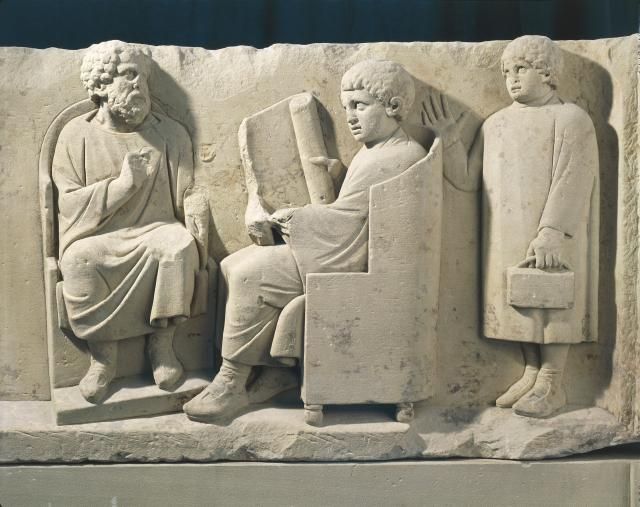
While the origins of the progymnasmata can be traced to educational practices as early as the 4th century BC, the method became increasingly formalised from the 1st century BC onwards through the publication of dedicated rhetorical handbooks. Over time, several prominent educators refined the curriculum and pedagogy further, ensuring its transmission across the ancient and medieval worlds. Amongst the most significant of these contributors are:
- Aelius Theon (1st century AD): Wrote the earliest surviving textbook. His version dealt principally with reading, analysis and writing variations of simple texts.
- Hermogenes of Tarsus (fl. c. AD 170): A famous prodigy rhetorician who streamlined the sequence. His handbook became immensely popular and was later translated into Latin by the grammarian Priscian, spreading the framework to Western Europe.
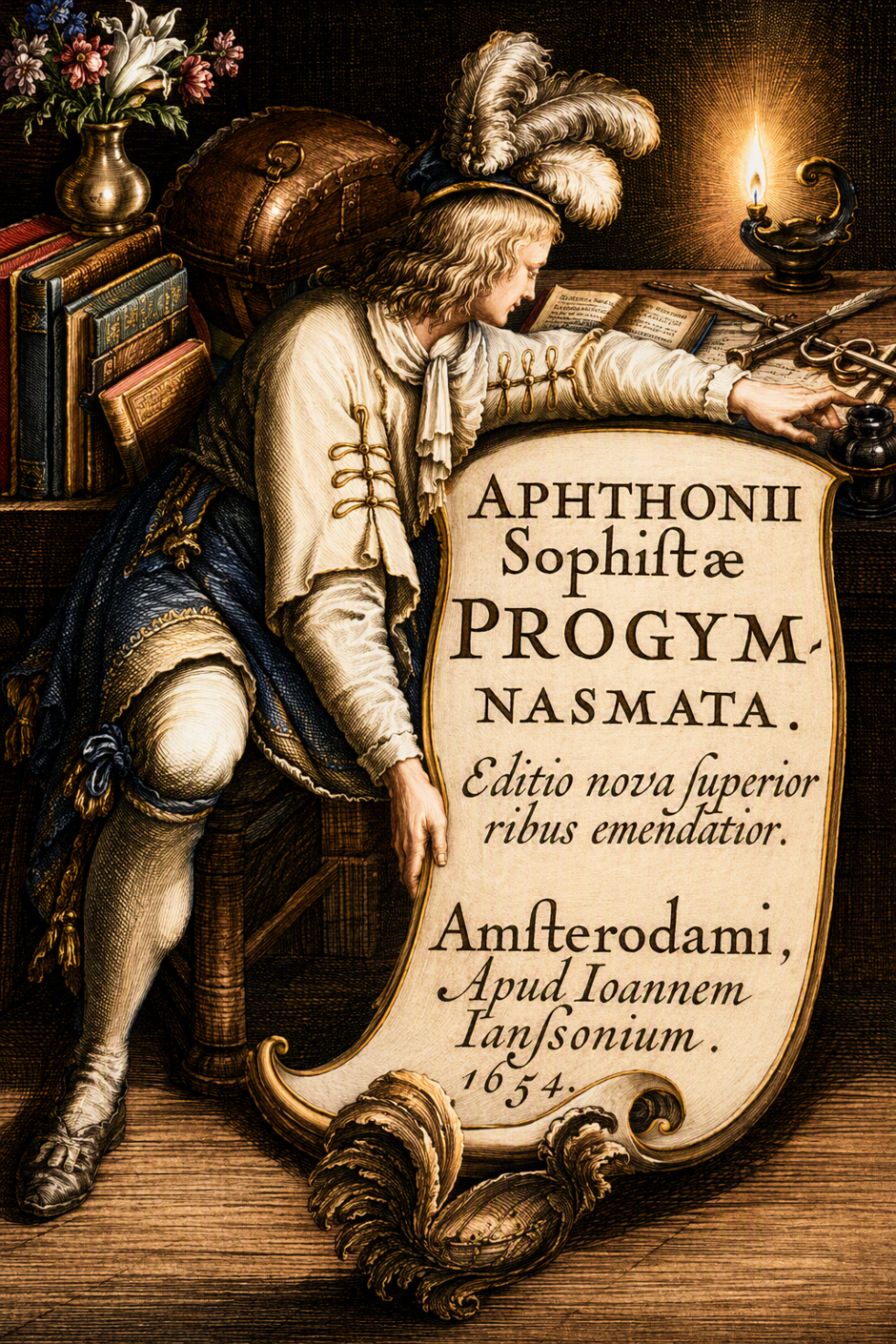
- Aphthonius of Antioch (fl. c. AD 315): A student of the great orator Libanius, Aphthonius wrote the definitive, most influential manual called Progymnasmata. He added clear, worked examples to every stage, making it the standard textbook used throughout the Byzantine Empire, the Middle Ages and the European Renaissance.
For these thinkers and their successors, the purpose of teaching according to the progymnasmata was to prepare young citizens to have moral self-control and engage in public life, where they would regularly call upon the skills learned to defend themselves in many professions.
Can we find the progymnasmata in the Australian Curriculum?
The short answer is: yes – but only in fragments. Before highlighting some elements that we do find, the main issue is what we don’t find. Largely absent are the progressive stages of the progymnasmata, building one upon one another, growing with complexity the abilities of the student. Furthermore, we don’t find the profound moral emphasis to rhetorical training that was always present in past education. Instead, the Australian Curriculum contains individual components of the tradition dispersed across different year levels and learning outcomes.
For example, from Foundation and Year 3, there are aspects of the first stage of the progymnasmata, such as requiring students to “re-read and re-tell text”, experiment with character voices and sequence events logically. Years 5-8 also contain some of the middle sequence of the progymnasmata, where students study how authors create aesthetic effects and are asked to “create literary texts… that experiment with text structures and language features” (like taking on the perspective of a character or historical figure), as we find in impersonation and description. Latter secondary school years engage students under the Literacy strand of the Curriculum to create “persuasive texts”, select evidence, analyse bias and systematically unpack arguments as found in the thesis stage.
While the Australian Curriculum therefore incorporates many of the individual skills cultivated in the progymnasmata, it does so without the integrated pedagogical framework that historically united them. The result is a collection of valuable rhetorical competencies taught in isolation rather than as a coherent progression that systematically develops students into accomplished communicators.
How can progymnasmata be adapted to education today?
For those interested in recovering this time-tested teaching method in rhetoric, there is encouraging news. Over the past twenty years, classical educators have spent considerable effort in modifying the progymnasmata to our contemporary academic settings while preserving its core pedagogical principles. For guidance in this area, please see the recommended resources below. However, for a specifically Australian adaptation of the progymnasmata no better resource is available today than the excellent work of Elizabeth Matheson through Via Classica, who has produced a number of textbooks that are extremely helpful for both teachers and students. They can be found here.
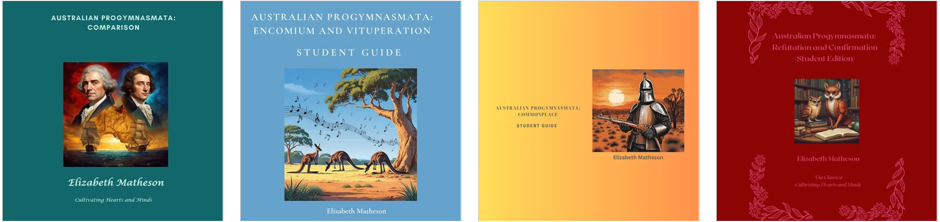
In general, the most successful adaptations of the progymnasmata today retain the progressive structure of the original exercises but update their content to reflect the interests and realities of modern students. Rather than drawing exclusively upon Greek mythology, Roman history or ancient statesmen, contemporary programs often utilise modern literature, current events, historical figures, films and popular culture as the subject matter for rhetorical training.
This approach preserves the essential educational insight of the progymnasmata: students learn best when they progress from imitation to invention, from concrete examples to abstract principles, and from guided practice to independent argumentation. Rather than confronting students with a blank page and expecting immediate originality, the method provides them with intellectual models, rich content and structured exercises through which creativity can gradually develop.
Consequently, the progymnasmata can be incorporated effectively into mainstream classrooms, homeschool programs, creative writing courses and classical schools alike. Its enduring value lies not in the specific historical examples it employs, but in its carefully graduated method of forming articulate, thoughtful and persuasive communicators.
Some step-by-step examples.
Fable (Level 1) – Students learn to retell a classic story, expand its details and explain its moral lesson.
Step 1: Choose a fable. Select a simple story, like The Hare and the Tortoise.
Step 2: Condense. Summarise the plot in one or two short sentences.
Step 3: Expand. Rewrite the story. Add dialogue between the animals. Describe the hot sun and the dusty road.
Step 4: Shift the perspective. Retell the story starting from the middle (the hare waking up from his nap) or from the end.
Step 5: State the moral. Conclude by explicitly stating the life lesson learned.
Chreia (Level 3) – Students learn to unpack a famous saying or action by an authoritative figure.
Step 1: State the saying. Present a quote, such as: Diogenes was asked what the best time for dinner was, and he replied, "If you are rich, when you will; if you are poor, when you can."
Step 2: Praise the speaker. Write a brief commendation of the speaker's wisdom or character.
Step 3: Paraphrase. Restate the quote clearly in your own words.
Step 4: Explain the cause. Discuss why the speaker said it and the truth behind it.
Step 5: Contrast. Show what happens if someone ignores this wisdom.
Step 6: Comparison. Match the idea with a parallel example from daily life or nature.
Step 7: Provide testimony. Quote another historical figure who agreed with this concept.
Step 8: Epilogue. Conclude with a brief summary statement.
Encomium (Level 7) – Students learn the formal art of praise, which lays the groundwork for writing persuasive essays.
Step 1: Introduction. Name the subject (e.g., St Augustine of Hippo) and praise their general excellence.
Step 2: Origin and ancestry. Describe their upbringing, country of birth and any noble traits of their parents.
Step 3: Education and training. Detail how they were raised and what skills they developed (e.g., being skilled in philosophy, tutored by Ambrose).
Step 4: Achievements. Group their great deeds into categories of the mind (wisdom), body (courage) and fortune (success).
Step 5: Comparison. Compare them to someone slightly inferior to highlight the subject's superior qualities.
Step 6: Conclusion. End with an exhortation or a prayer, reminding the audience to emulate their virtues.
What are some recommended resources for learning more about progymnasmata?
- The Progymnasmata: Classical Writing with Benjamin Lyda
- Scriptorium Writing guide books, primer, teacher’s guide and Levels One-Five by Benjamin Lyda. The books guide students through exercises of the stages of progymnasmata and can be found here.
- Writing and Rhetoric series by Paul Kortepeter and Christopher Perrin. Published by Classical Academic Press, this 12-book series breaks down the progymnasmata into highly accessible, engaging lessons for younger grades. They can be found by searching the online shop here.
- Classical Composition series by James Selby is a highly structured, sequential program (from fable to encomium) that outlines exactly how to teach the classical "canons" of rhetoric. They can be found at Memoria Press's online shop here.
- An excellent outline of the progymnasmata from Brigham Young University with detailed examples of each stage.
- Similar to the above resource, this pdf has detailed examples for each stage from the University of Massachusetts Amherst.
- For those interested in a more detailed look at the original ancient texts (in translation) and discussion of them and the progymnasmata teaching method, see George A. Kennedy's Progymnasmata: Greek Textbooks of Prose Composition and Rhetoric.