…the culture of Europe has deteriorated visibly within the memory of many who are by no means the oldest among us. And we know, that whether education can foster and improve culture or not, it can surely adulterate and degrade it. For there is no doubt that in our headlong rush to educate everybody, we are lowering our standards, and more and more abandoning the study of those subjects by which the essentials of our culture – of that part of it which is transmissible by education – are transmitted; destroying our ancient edifices to make ready the ground upon which the barbarian nomads of the future will encamp in their mechanised caravans.
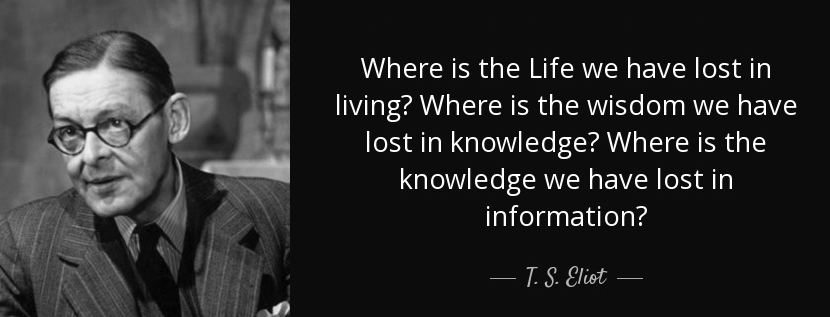
In his 1949 book Notes Towards a Definition of Culture, T.S. Eliot argued for a view of culture challenged by many and multifarious voices in post-Second World War Britain. His perspective defending a culture that grew organically from the interplay between the Christian religion and social hierarchy rubbed against the egalitarian, secular voices resounding from Whitehall. While the entire work is a fascinating read that causes one to reminisce somewhat on a bygone era, the main concern of this piece is to reflect on what Eliot has to say regarding education, which comes primarily from the final chapter: “Notes on Education and Culture.”
Commentators on the direction education is taking in our society tend to first begin by philosophising on its purpose. Eliot doesn’t dispute that a purpose of education is “to transmit culture” but that it cannot be limited to “the educational system”, going beyond the collection of skills and knowledge that form the interpretive framework of the world in which we live. He is also sceptical that there is some “personified community” – such as a government bureaucracy – that serves as the repository of and authority over culture and the education that devolves from it.
Likewise, identifying education’s goal as securing “for children a happier childhood and a better start to life” (to quote the White Paper, “The Government’s Purpose”, 1943), or more simply, overall happiness for those educated, is not incorrect but certainly does not give the whole story, as too much education, like too little, can produce unhappiness instead.
Although sympathetic with both the above purposes, Eliot himself is in greater agreement with those who recognise a number of diverse ends in education, for instance, those adumbrated by C.E.M. Joad (in About Education, 1945), who argues that education should foster the “whole person” (intellectually, morally and spiritually), and more specifically these three goals:
- To enable a boy or girl to earn his or her living…
- To equip him to play his part as the citizen of a democracy.
- To enable him to develop all the latent powers and faculties of his nature and so enjoy a good life.
Yet, even these purposes, Eliot considers incomplete or too socio-specific. In a paragraph that could have been written today, he states:
“What we remark especially about the educational thought of the last few years, is the enthusiasm with which education has been taken up as an instrument for the realisation of social ideals. It would be a pity if we overlooked the possibilities of education as a means of acquiring wisdom; if we belittled the acquisition of knowledge for the satisfaction of curiosity, without any further motive than the desire to know; and if lost our respect for learning.”
These reflections provide us a simple yet profound truth: Education, as a product of society, does serve broad political and economic outcomes; however, more importantly, as an essential human endeavour, education serves to satisfy the inward yearnings of the human soul (for knowledge, wisdom and happiness).
Another lesson for our times comes from Eliot’s warning against employing education as the means by which we ensure equality of opportunity and, worse, outcome, so that social success would only be available to those who have achieved certain academic qualifications or passed their exams. This is undesirable as a measure of human worth. Moreover, it would lead to a uniform system where no one capable of receiving higher education could fail to attain it, resulting in the “higher education” of the vast majority of the population which would inevitably lower academic standards to satisfy mass success. There is a trend in modern society, Eliot believes, of idealising education: it is the abstract bar against which everyone is measured, such that, people are “more” or “less” educated by this measure and those of the past are barely seen as educated at all!
For Eliot’s aristocratic mind (that is, one who appreciates and promotes human excellence), the “dogma of equal opportunity” in education and other societal spheres, is “an ideal which can only be fully realised when the institution of the family is no longer respected, and when parental control and responsibility passes to the State. Any system which puts it into effect must see that no advantages of family fortune, no advantages due to the foresight, the self-sacrifice or the ambition of parents are allowed to obtain for any child or young person an education superior to that to which the system finds him to be entitled”. He regards equal opportunity as being driven (at least in England during the first half of the twentieth century) by envy at the class system. Today, we may wonder whether recent DEI initiatives are likewise born from a form of “envy towards equality” against Anglo-European culture.
For all their merits, schools within the education system can only be effective in part; they rely on outside influences: family, work, play, the media, and general environment, all being in harmony with them. We submit our children to the system because there is this belief that a certain culture is worthy above others. However, this can create a deeper problem. Eliot states: “There is also the danger that education – which indeed comes under the influence of politics – will take upon itself the reformation and direction of culture, instead of keeping to its place as one of the activities through which culture realises itself.” He speaks to us today. It would be wise to take Eliot's counsel and treat education as the handmaiden of culture (religion, social interactions and hierarchies, the family, an so on) rather than the master disciplining into submission all else under its outstretched arms.