With the growing interest in classical education in Australia, amongst educators and parents, it is only fitting to revisit Mortimer Adler’s seminal work, The Paideia Proposal. Published in 1982, The Paideia Proposal is Adler’s educational manifesto as a solution to America's education system. While referring to the American educational landscape, Adler’s proposal can help to serve the Australian context.
As a resource, The Paideia Proposal provides a framework for developing an education curriculum grounded in the classical education model. Adler begins by asserting that students should be provided with a “same course of study” devoid of “subject specialisation”, one of which there are unified objectives. As an exception to Adler’s position against electives, he does stress the importance of incorporating both physical education and language learning in the framework. Based on Adler’s diagram in the book, this ‘same course of study’ curriculum can be understood as such:
Column One: focuses on knowledge acquisition from didactic instruction, textbooks, and other learning materials. In this column, Adler considers language, literature, and fine arts; mathematics and natural sciences; history, geography, and social sciences as the three key fundamental branches of learning.
Column Two: continues the development of intellectual skills of learning by coaching and supervised practice through these areas of study: reading, writing, speaking, and listening; calculating, problem-solving, measuring and estimating; and the use of critical judgement.
Column Three: builds on understanding of ideas and values through Socratic questioning and active participation through the discussion of literature, artworks, and other artistic activities such as music and drama.
This framework serves as the foundation of what can be considered in alignment with the liberal arts tradition. An intellectual tradition that prioritises an interdisciplinary approach to learning as a means of developing the critical, spiritual, and emotional faculties of an individual.
Adler’s goal to bring about a reform of the public schooling system in America is rooted in the idea that change begins on a local and community level. His vision echoes that of his predecessor, John Dewey, who linked education with democracy, and more importantly, the claim that “a democratic society must provide equal educational opportunity”. In this light, to embark on an education reformation can positively impact opportunities for the next generation, economic prospects, and, on a larger scale, democratic institutions. He advocates that all children are “educable”, dependent on their own capacity, and this must be based on receiving the same “quality of education”.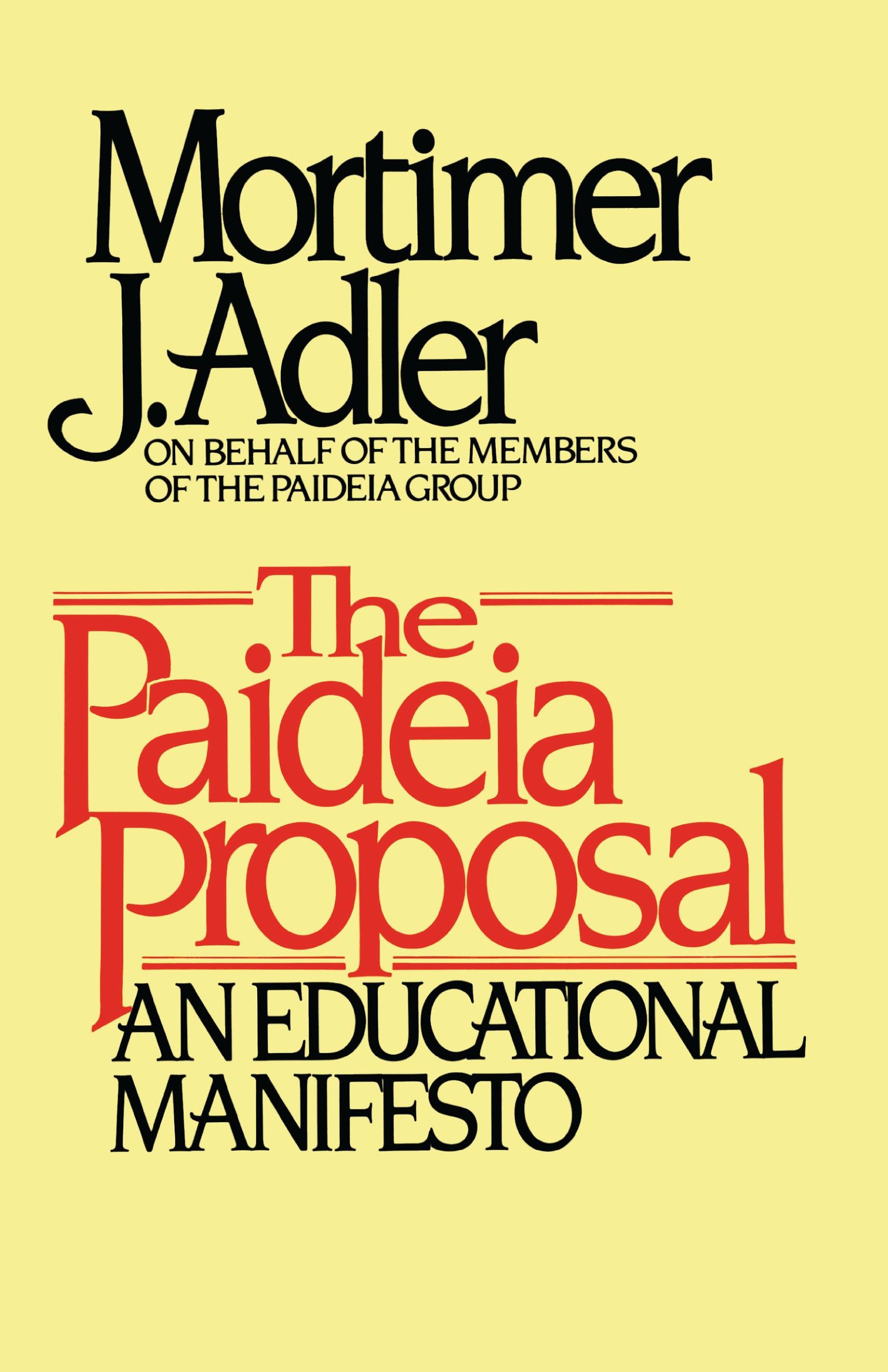
Within the Australian education context, Adler’s proposal demonstrates organising a curriculum that prioritises first and foremost the acquisition of information, the development of skills, and then exposure to literary and aesthetic traditions. In comparison to what may seem within our current education system as fragmented, discrete, and incoherent, this framework draws upon an interconnected approach where meaning from ideas, books, and art can be developed. Instead of teaching students through a broad coverage approach where skill sets and units are to be checked off, the proposal illustrates the value in the development and cultivation of a liberal arts foundation. In one example drawing from the visual arts tradition, this might involve: learning about art movements to provide a foundation, followed by a closer examination of materials and methods, and exposure and engagement with masterpieces.
For parents and educators seeking more from education and from students, this proposal guides us in the direction of re-instilling tradition and wisdom in the hands of future generations. It's not so much about a checklist of accomplishments, but instead a collection of insights distilled from wisdom that has come before us all. This knowledge is drawn from the great works of classical thinkers and writers who continue to offer value within the 21st century.
Over four decades later, Adler’s proposal remains relevant as the same concern and desire for reform in the declining quality of public schooling in America is also shared by parents, teachers, and leaders here in Australia. Education, therefore, is not to be perceived as serving only vocational purposes but also in cultivating the mind, body, and spirit, well beyond schooling years. For Adler, education is a lifelong process, and his proposal serves as a reminder not just for educational reform but also for the continued pursuit of education outside of a school context. Here in Australia, we too can help shape the process by understanding that an individual holds a significant role in the well-being and flourishing of the city, the state, and the nation.
__________________________________________________________________
Work consulted:
Adler, Mortimer J. The Paideia Proposal. Simon & Schuster, 1998.